The Farmer's Bride
Charlotte Mew's 'The Farmer's Bride' is a haunting dramatic monologue exploring the tragic breakdown of a marriage from the perspective of an emotionally stunted farmer. It offers profound opportunities to analyse power dynamics, isolation, and the devastating impact of patriarchal expectations, making it highly rewarding for high-level exam responses.
Study Notes
Overview
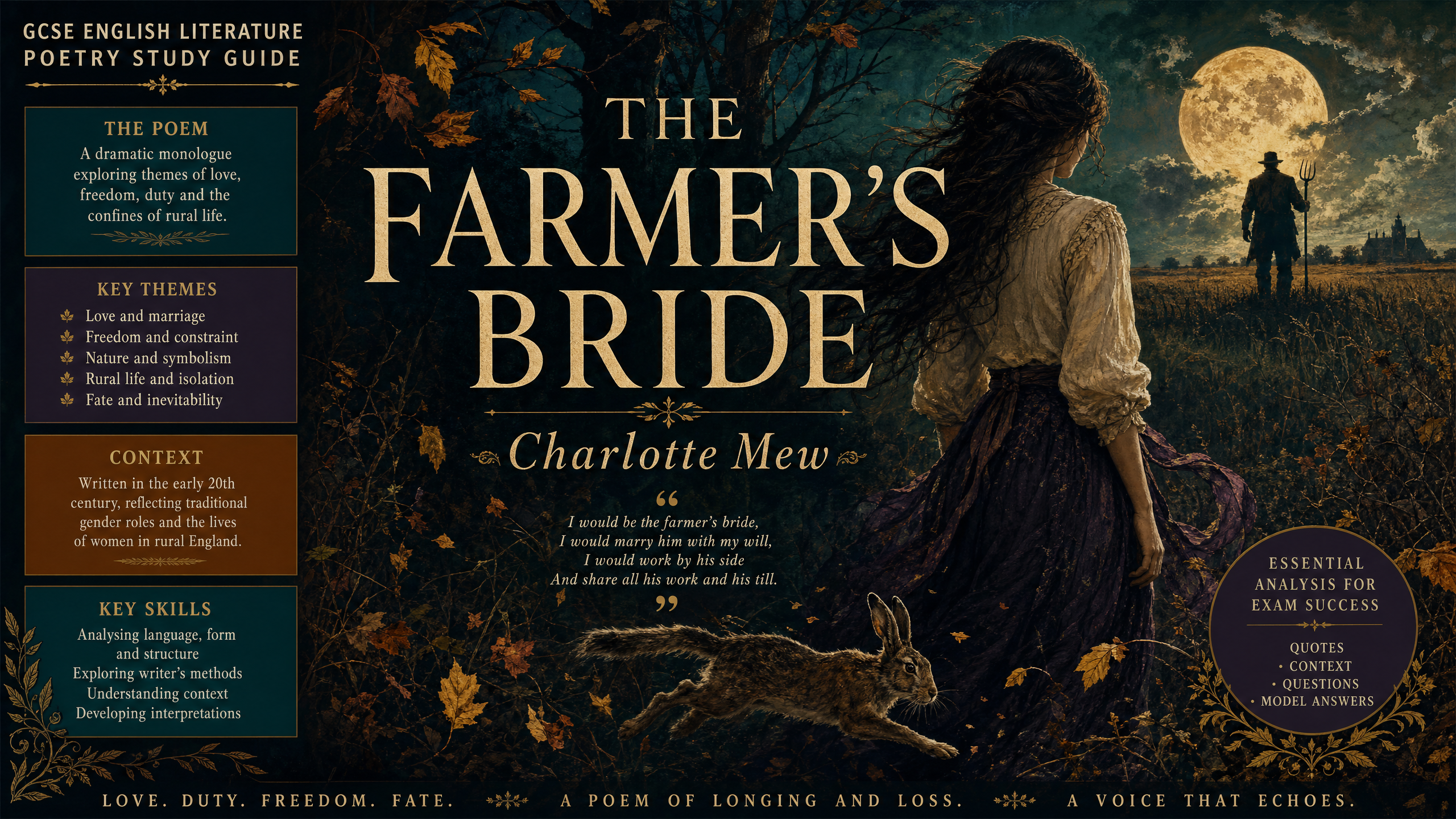
Charlotte Mew's 'The Farmer's Bride' (1912) is a powerful exploration of unrequited desire, isolation, and patriarchal control. Written as a dramatic monologue from the perspective of a rural farmer, it details his marriage to a young woman who becomes terrified of him and flees, only to be hunted down and locked away. Examiners look for candidates who can look past the farmer's narrative to identify the silent suffering of the bride, rewarding close analysis of the poem's irregular form, its vivid natural imagery, and its critique of early 20th-century gender roles.
Plot/Content Overview
- Stanza 1: The farmer recounts marrying his bride "Three Summers since" when she was "too young maybe". Shortly after the wedding, she becomes terrified and withdrawn.
- Stanza 2: The bride runs away. The farmer and the local community hunt her down like an animal ("we caught her, fetched her home at last").
- Stanza 3: She is locked in the house. She does her chores but remains completely silent and fearful of men.
- Stanza 4: The farmer compares her to various animals and notes how she communicates only with the natural world, remaining "Out of reach of the eyes of man".
- Stanza 5: Winter approaches. The isolation of the farm mirrors the emotional distance between the couple.
- Stanza 6: The poem concludes with the farmer's overwhelming, frustrated physical desire for his wife, who sleeps alone just a staircase away.
Themes
Theme 1: Power, Control and Patriarchy
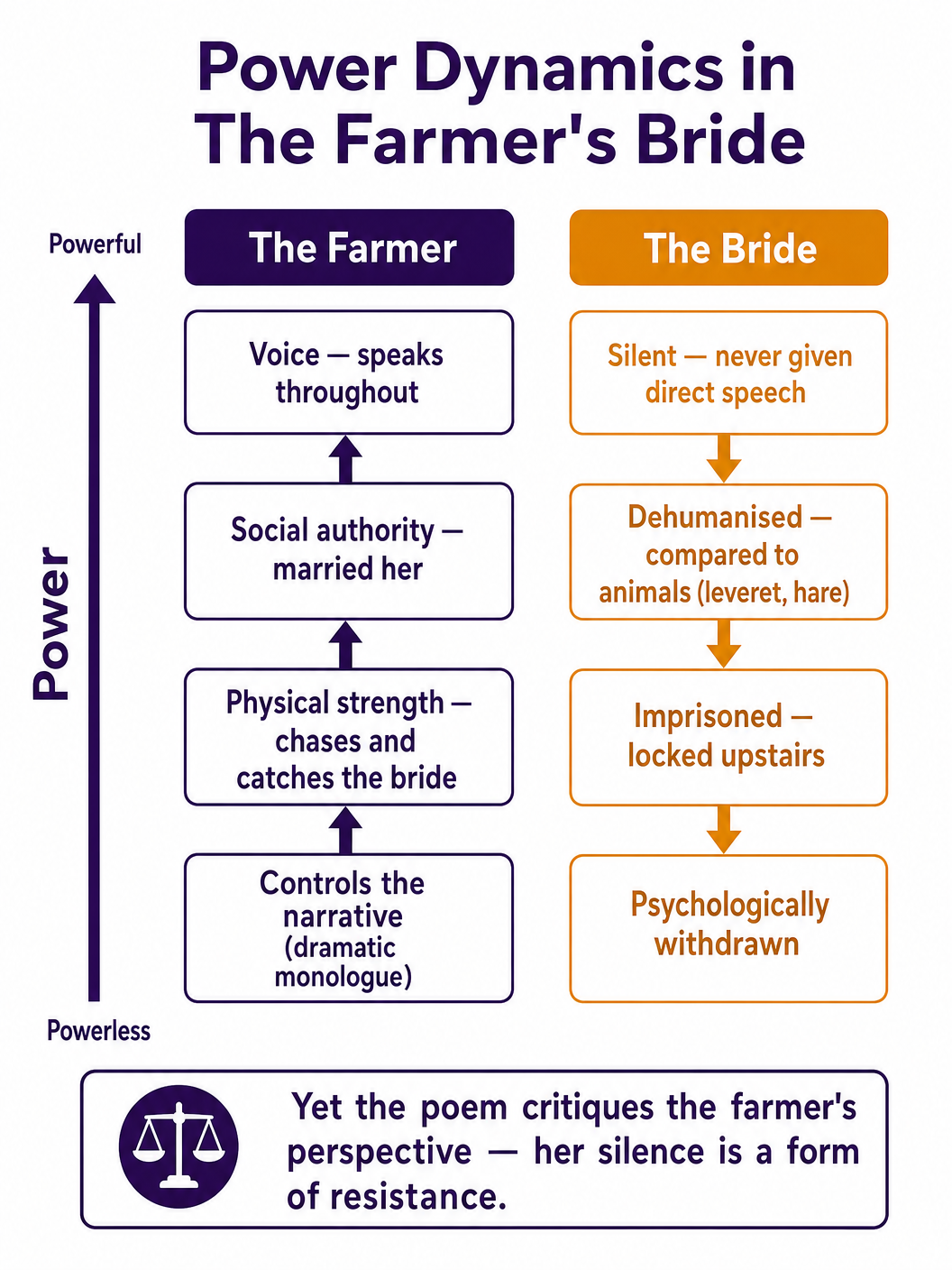
The poem exposes the stark power imbalance in early 20th-century rural marriages. The farmer holds all the structural power—he speaks, he commands the community, and he physically imprisons his wife. Yet, the bride exerts a subversive power through her silence and refusal to submit emotionally.
Key Quotes:
- "we caught her, fetched her home at last" - The collective pronoun "we" shows patriarchal solidarity. The verbs "caught" and "fetched" reduce her to an object or an escaped animal.
- "And turned the key upon her, fast." - The physical act of imprisonment highlights his ultimate control, but also his failure to win her affection.
Theme 2: Isolation and Alienation
Despite living in the same house, the couple is profoundly isolated. The farmer is isolated by his inability to understand his wife's emotional needs, while the bride is alienated from human society, finding solace only in nature.
Key Quotes:
- "Not near, not near!" - The repetition emphasizes the vast emotional distance between them, despite their physical proximity.
- "What's Christmas-time without there be / Some other in the house than we!" - The farmer feels the acute loneliness of their childless, loveless marriage, especially during a time of traditional familial warmth.
Theme 3: Desire and Frustration
The farmer's desire is entirely physical and entirely unrequited. His frustration builds throughout the poem, culminating in a disturbing climax where his longing threatens to overpower his control.
Key Quotes:
- "the brown of her—her eyes, her hair, her hair!" - The fragmented syntax, repetition, and exclamation mark in the final line demonstrate the farmer's loss of emotional control and his obsessive physical focus.
- "'Tis but a stair / Betwixt us." - The physical proximity tortures him, highlighting the insurmountable psychological barrier between them.
Character Analysis
The Farmer
Role: The narrator and the embodiment of patriarchal expectation.
Key Traits: Emotionally illiterate, physically imposing, deeply frustrated.
Character Arc: Moves from confused recollection of their early marriage to overwhelming, barely contained physical desire.
Essential Quotes:
- "I chose a maid"
- "her hair, her hair!"
The Bride
Role: The silent subject of the poem; the victim of forced domesticity.
Key Traits: Fearful, deeply connected to nature, silent, resistant.
Character Arc: She begins as a "maid", attempts to escape, is captured, and retreats into total psychological withdrawal.
Essential Quotes:
- "more like a little frightened fay"
- "like a mouse"
Writer's Methods
Form and Structure
Dramatic Monologue: Mew uses this form to trap the reader inside the farmer's perspective. The bride's silence is deafening; her lack of voice perfectly mirrors the silencing of women in society. Examiners reward candidates who point out that the farmer is an unreliable narrator.
Irregular Rhythm and Rhyme: While loosely based on a ballad metre, the poem's rhyme scheme and line lengths are highly irregular. This structural instability reflects the farmer's growing frustration and emotional turmoil. Enjambment is used to show his racing thoughts, while caesurae often highlight his sudden, painful realisations.
Language and Imagery
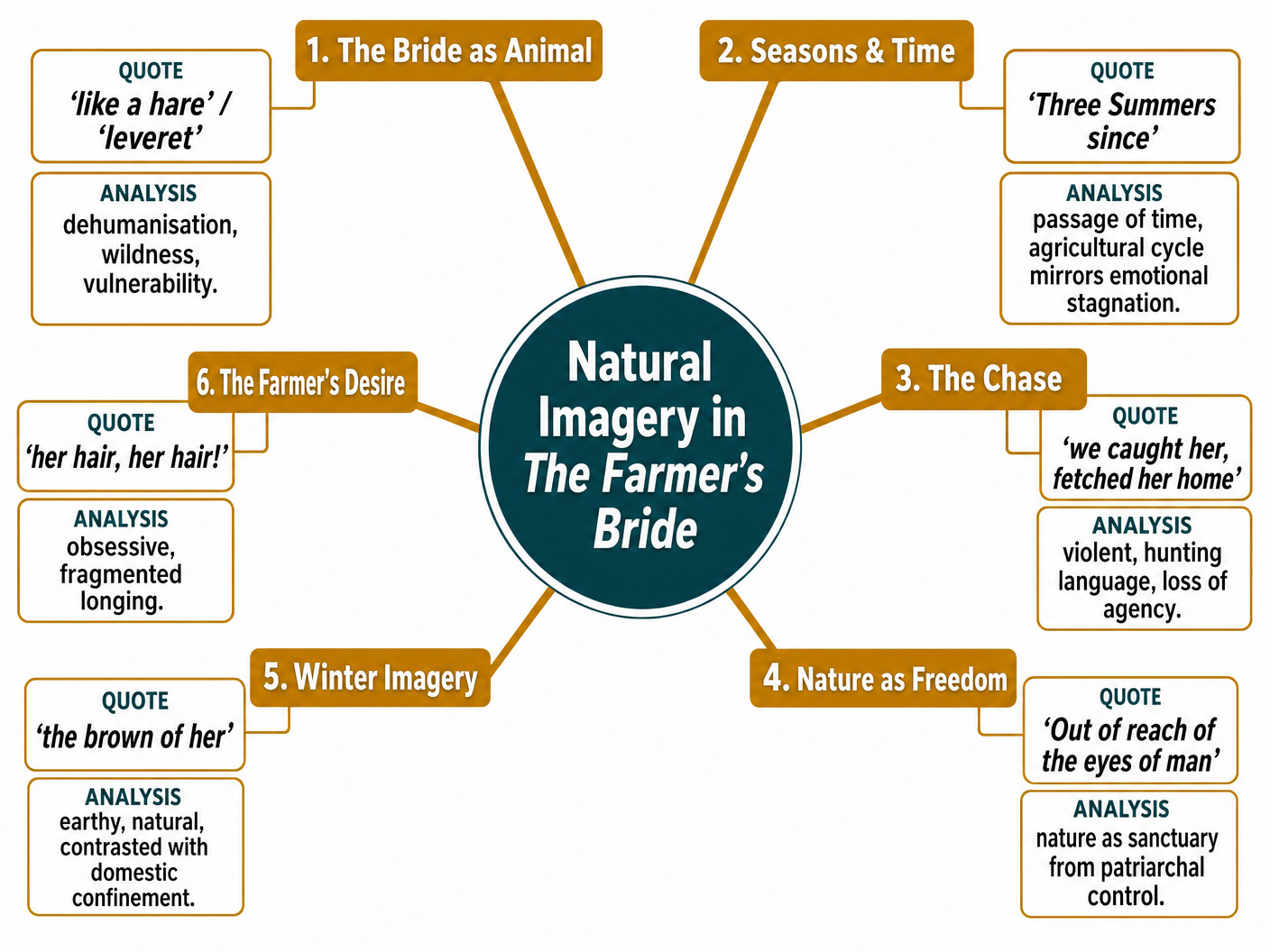
Animal Imagery (Zoomorphism): The bride is constantly compared to animals: a "hare", a "leveret", a "mouse". This highlights her vulnerability and wildness, but also exposes the farmer's predatory nature. He views her as livestock to be tamed rather than a human partner to be understood.
Natural Imagery: The changing seasons map onto the emotional landscape of the poem. The transition from "Summers since" to the harsh, isolating "Winter" reflects the death of any hope for their relationship.
Context
Written in 1912, the poem sits on the cusp of the modernist movement. It reflects growing contemporary anxieties about the institution of marriage, the subjugation of women, and the misunderstanding of female mental health. In rural Victorian and Edwardian society, women were often viewed as property, and marriages were pragmatic rather than romantic. The bride's "madness" can be read as a rational trauma response to a forced sexual and domestic situation—a nuance that examiners highly reward.
Visual Resources
2 diagrams and illustrations
Interactive Diagrams
1 interactive diagram to visualise key concepts
Conceptual Flow Outline
Narrative Arc and Seasonal Structure in The Farmer's Bride
Worked Examples
1 detailed example with solutions and examiner commentary
Practice Questions
Test your understanding — click to reveal model answers
Compare how poets present feelings of longing and desire in 'The Farmer's Bride' and one other poem from your anthology.
Hint: Focus on how the desire in this poem is unrequited, physical, and potentially threatening. Compare this to a poem where desire is mutual (e.g., Singh Song!) or equally destructive (e.g., Porphyria's Lover).
How does Mew present the effects of isolation in 'The Farmer's Bride'?
Hint: Consider both the bride's physical isolation (locked away) and the farmer's emotional isolation (unable to connect with her).